


















A stone uncovered at Fortuna’s Roman baths could be part of something much bigger than the fragment archaeologists have recovered. Researchers believe the original inscription may have stretched for at least 4.8 metres, making it one of the most unusual discoveries of its kind in the Iberian Peninsula.
The inscription is almost 2,000 years old, but much of its message remains a mystery. What researchers have found so far, however, is already offering some interesting clues about Fortuna’s place in the Roman world.
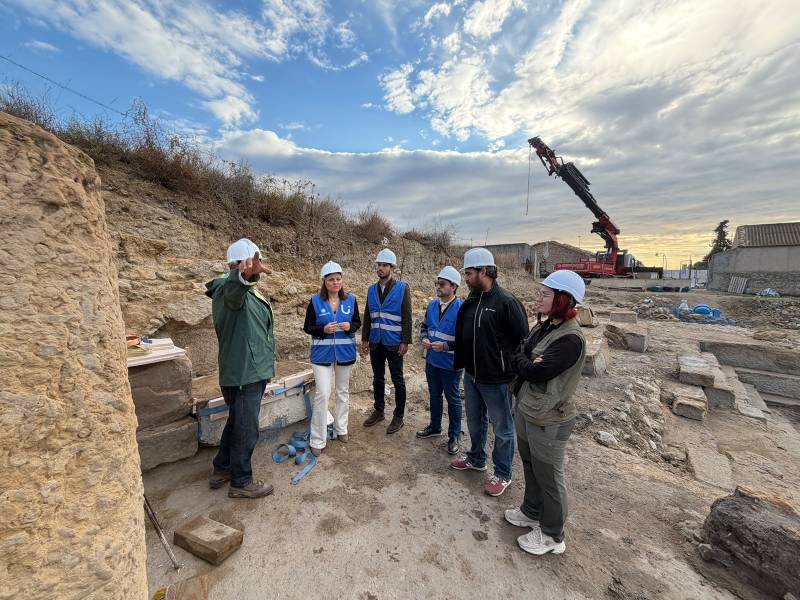
The discovery was made during excavations led by Gonzalo Matilla of the University of Murcia. While clearing an area affected by the collapse of an old structure, the team came across a large stone block that had been reused in a later wall.
The surviving fragment measures almost 90 centimetres and carries two lines of text surrounded by decorative mouldings. It's the lettering that makes the find particularly interesting. The largest letters measure 23 centimetres high, a size rarely seen on Roman inscriptions.
In the Region of Murcia, only three other known inscriptions have letters of a similar size, and all were discovered in Cartagena, the ancient Roman city of Carthago Nova.
Researchers have managed to identify part of a Roman name on the Fortuna stone. Although its exact age has yet to be established, the inscription is provisionally dated to between the late first century BC and the second century AD. Some of the evidence points towards a possible connection with Emperor Augustus, Rome's first emperor, who ruled from 27 BC to AD 14.
The size of the lettering has also helped archaeologists estimate the inscription's original length. They believe it may have formed part of a commemorative monument, although further research is needed to establish where it once stood and what the complete message said.
The fragment is being recovered for transfer to the Archaeological Museum of Murcia, where specialists will study and preserve it.
Patricio Sánchez, the regional director general for Cultural Heritage, said: "We are looking at an exceptional archaeological find, both because of its dimensions and the historical information it could provide about one of the most important thermal complexes in the Region of Murcia."
The discovery is part of a €150,000 archaeological campaign funded by the regional government. Excavations have also cleared the pool of the ancient bathing complex and revealed the outline of its main building, giving researchers a clearer picture of how the site was arranged almost two millennia ago.
Declared a Site of Cultural Interest in 2016, Fortuna's Roman baths have been studied for years. This latest find adds another piece to the story, although archaeologists still have plenty to uncover about the people who used the complex and the role it played in Roman life.
Image: CARM