








Rural murals in the villages and outlying districts of Lorca!
The traditional identity of villages from Coy in the north to Aguaderas in the south
 Given that Spain is divided into no fewer than 8,132 it might appear logical to assume that most of them are rather small, and indeed in many cases this is true.
But Lorca is one of the most notable exceptions, occupying an area of a staggering 1,675 square kilometres – the second largest in Spain (after Cáceres in Extremadura). To put that into perspective for English readers, it’s slightly bigger than Surrey, but of course with a far lower population (98,000 as opposed to 1.1 million)!
And much of the terrain is fairly unforgiving: particularly in the north, there are mountains and valleys interspersed by high plains, and in this rugged landscape population centres are few and far between. However, as you drive around (and a tour around northern Lorca can easily take a whole day!) you come across numerous hamlets and villages, each with its own identity, traditions and predominant agriculture, from cereal crops to pig farming to olives, almonds and grapes (from which some appropriately robust red wine is often made).
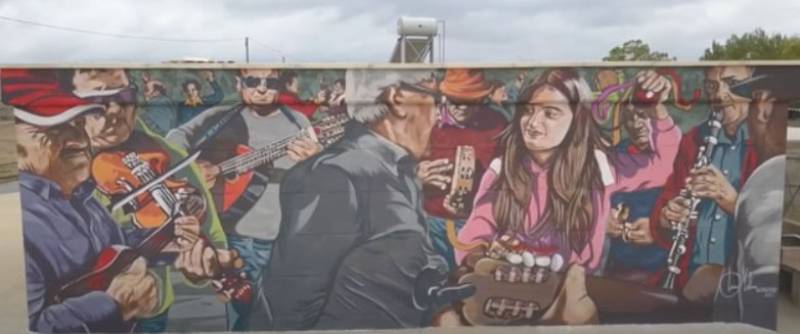
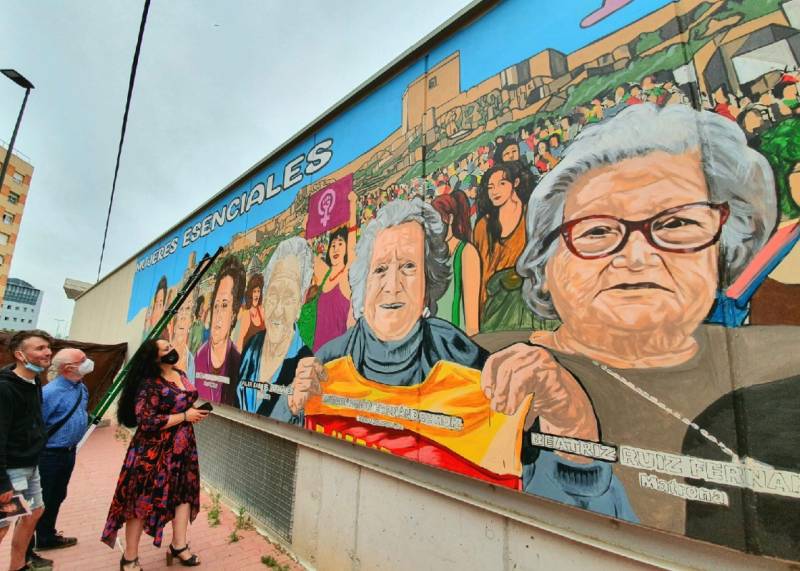
In recent years, in the face of the rural depopulation which is common all over Spain and most of Europe, efforts have been made to preserve and strengthen the local identity an character which preserves these rural outposts, and one of the most eye-catching ways in which the task has been approached in Lorca is the creation of a series of murals in each village depicting typical scenes from daily life in all of the locations. These form part of the “Murales en las Pedanías” catalogue and range from olive picking to local fiestas and family life, and they serve to reinforce the concept of hardship but satisfaction which is so familiar to those who live in the countryside of Lorca.
 The locations at which these murals are listed include the following:
La Pulgara – Artichoke picking is in full flow as two gentlemen stand outside the 150-year-old Casa de los Calistros. One of them is Patricio Simón, who was a local pioneer in the farming of artichokes in the 1960s, and the other is Bartolo, who was an enthusiastic photographer and left a great legacy in the archives of Lorca.
Cazalla –A work by Iván Molina on the outside of the changing rooms in the park, next to the sports area and the canteen. 12.20m x 3.8m, it shows typical activities including children going to school and elements of the local agricultural activity, including artichoke picking. The Casa Mula is in the background.
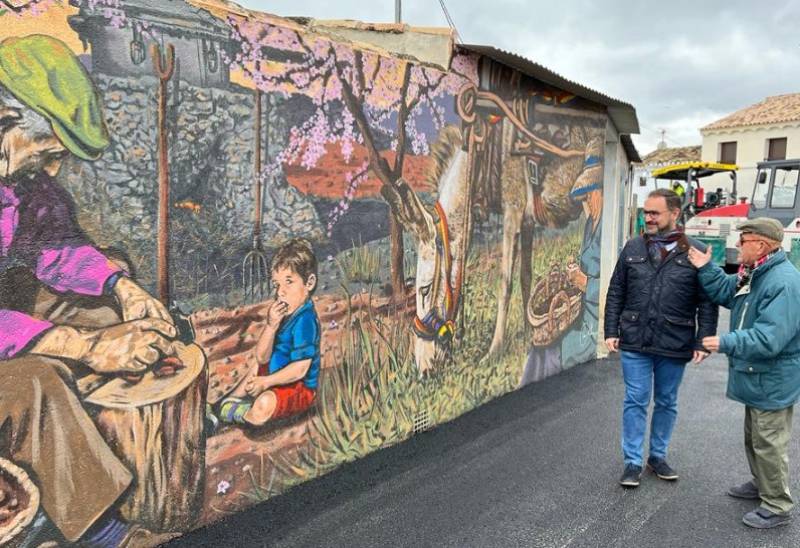 Aguaderas – Another painting by Iván Molina, 8.2m x 7m, on the outside of the medical surgery. The musicans of the local “cuadrilla” can be seen playing outside the church.
Río / Barranco Hondo – Iván Molina has decorated one of the walls of the 2- storey Local Social with this large painting of 14.4m x 4.93m. The images reflect the sulphur mining past in the Sierra de la Serrata.
El Consejero – Another one on the Local Social, measuring 7.1m x 3.9m. In the image we can see the Cejo de los Enamorados, the church of El Pradíco and the old aqueduct.
Campo López – Off the old mountain road between Mazarrón and Lorca, very close to the coast although you wouldn’t know it when you’re in the village (!), this mural can be found on the side wall of the Centro Social in Calle Eternidad, next to the church of San Pedro Apóstol. 6.5m x 5.26m. The image shows an eagle soaring over the landscape.
Campillo – Showing the hot work of harvest in the cereal fields, this painting on the side of the Asociación de Vecinos measures 8.1m x 2.91m. Unfortunately, 99% of the cereal crop land in the Guadalentín valley has not been lost, so this image harkens back to the past.
Almendricos – This picture shows the railway station and is on the wall of the Centro Médico in Calle Patrón. 13.38m x 3.66m.
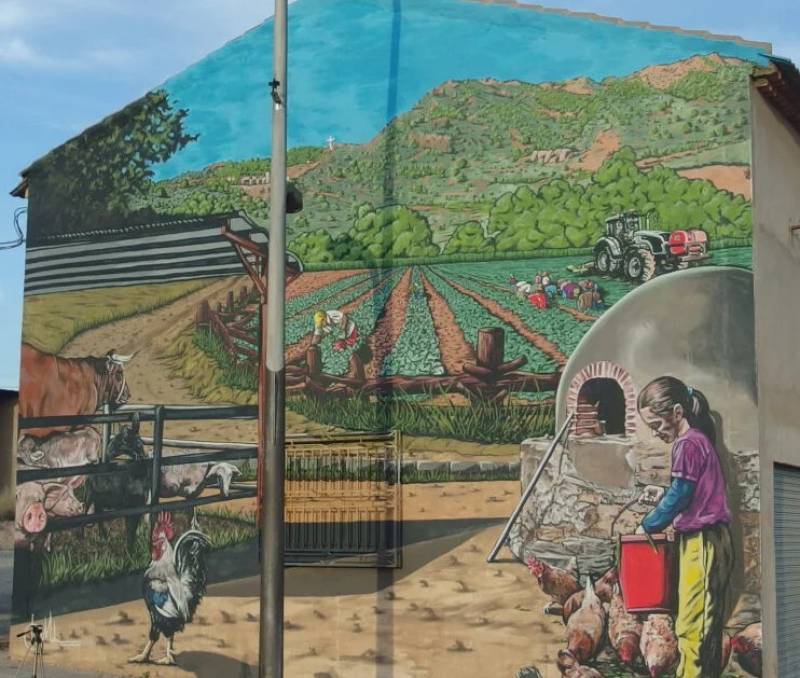
La Hoya – La Hoya is nowadays a more industrial town just a couple of kilometres from Lorca itself, but the mural is a farmyard scene showing a young girl feeding chickens in a farmyard, a scene which can still be seen outside the centre of the town in the Guadalentín valley.
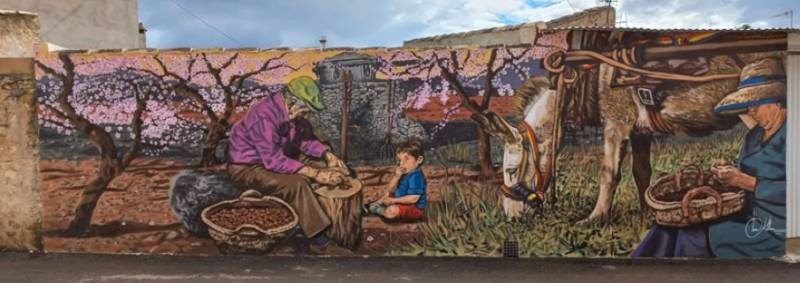 Torrealvilla – Traditional “cuadrilla” musicians liven up this 11x4m image on the side of the Centro Cívico Juan Perán Ramos, reflecting the Cuadrillas festival which is held here every year over the last weekend of February.
La Tercia – Women dance on the walls of the Centro Cultural!
Las Terreras – Two grandchildren and their grandson grab a bite to eat against a backdrop of almond blossom in the background.
El Rincón de Los Carranzas – Occupying two walls, this scene shows the village below the mountain of El Sordo, complete with its washhouse and a young girl playing with one of the wild tortoises which can be found in the area. This is a nostalgic scene as unfortunately only one child currently lives in El Rincón de las Carranzas!
On the other wall a neighbour named Ana Mari is picking olives under the watchful eye of her dog Toni.
La Tova / La Parroquia – The mural is on the side of the Centro Social.
 Doña Inés – A country scene adorns the side of the agricultural weighing scales.
Coy – A colourful image decorates the Centro de la Mujer.
Avilés – An old lady cuts a bunch of grapes from the vine on the wall of the Centro de la Mujer.
Torrealvilla / Zúñiga – A cyclist enjoys the countryside on the side of the church and Centro Social.
Zarzadilla de Totana – A magnificent bird of prey adorns the sports pavilion with the mountains of the foothills of Sierra Espuña in the background.
Zarcilla de Ramos – A child on a swing outside the Centro Social de la Tercera Edad.
La Paca – A happy child in the play area outside the local church.
For more local information about Lorca, including news and what’s on, visit the home page of Lorca Today.
Oficina de Turismo de Lorca
The rich and extensive history of Lorca has left a legacy of archaeological sites and historic buildings around which the modern city has built its tourism industry. Amongst these are Lorca Castle, Plaza de España, the former Collegiate church of San Patricio, the municipal archaeological museum, the Casa Huerto Ruano, the Palacio de Guevara and the churches and convents of San Francisco, San Mateo, the Virgen de las Huertas, La Merced, El Carmen and many others.
Unfortunately, Lorca has been prone to natural disaster, suffering a severe flood in 1973 which killed 50 people, and a Gota Fría on September 28th 2012, as well as a series of earthquakes, the most recent of which was 5.3 on the Richter scale on 11th May 2011 and claimed 9 lives.
 Lorca also has an area of unspoilt coastline incorporating the Parque Regional de Cabo Cope - Puntas de Calnegre, which includes the beaches of Puntas de Calnegre, Cala Calnegre and various others. Although only one is accessible by road others can be reached along dirt tracks!
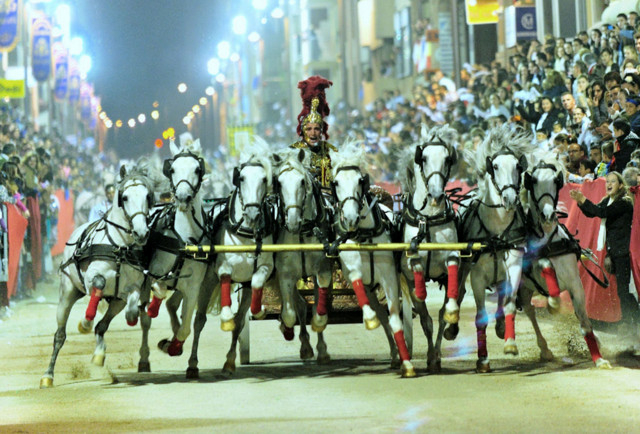
In terms of fiestas, Lorca is synonymous with Easter (Semana Santa), its biblical parades of International Tourist Interest status being famous throughout Spain. The week includes a series of parades in which the whites (Paso Blanco) and blues (Paso Azul) try to outdo each other with the magnificence of their embroideries and the skill and daring of their horsemen.
In the Autumn Lorca also celebrates the Fiestas of San Clemente and a Feria and there are a series of important events throughout the year in the Recinto Ferial, as well as a busy cultural and sporting programme.
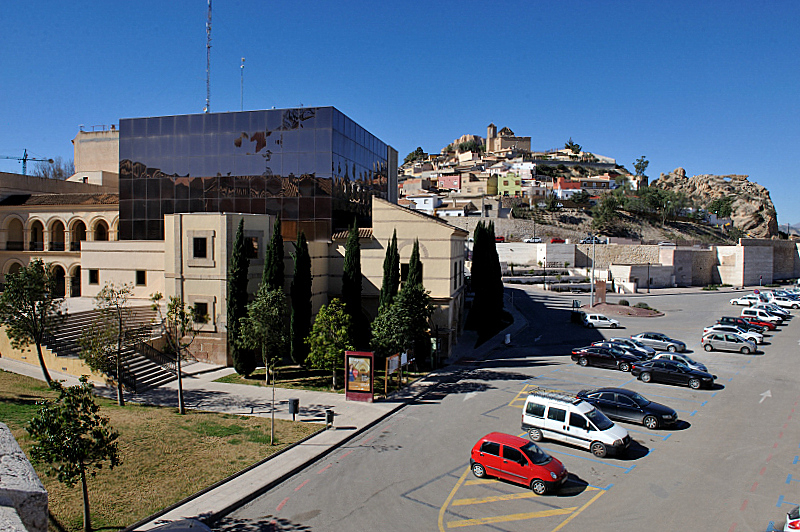
The tourist office relocated for 14 years to Calle San Patricio, near the church, but has now returned to its former premises alongside the Palacio de Guevara in the Plaza Concha Sandoval, or Plaza de la Bordadora (click for map).
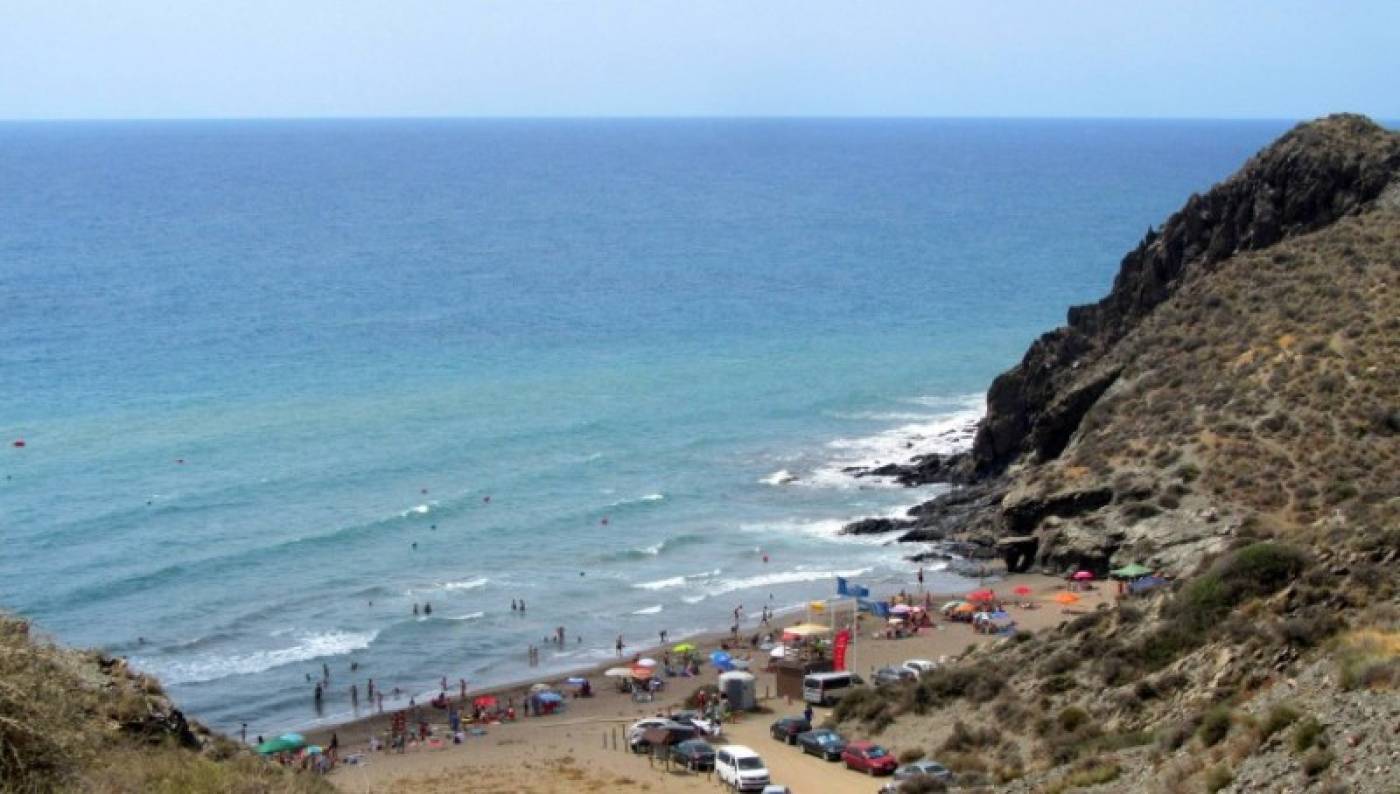 Lorca also has an area of inspoilt coastline incorporating the Parque Regional de Cabo Cope - Puntas de Calnegre, in the Sierra de Almenara, which includes the beaches of Puntas de Calnegre, Baño de las Mujeres, San Pedro, El Siscal, Cala Honda, Cuartel del Ciscar, Junquera, Cala de la Gruta, Cala Leña, Los Hierros, Cala Blanca and Playa Larga, although many are accessible only along difficult tracks or by boat!
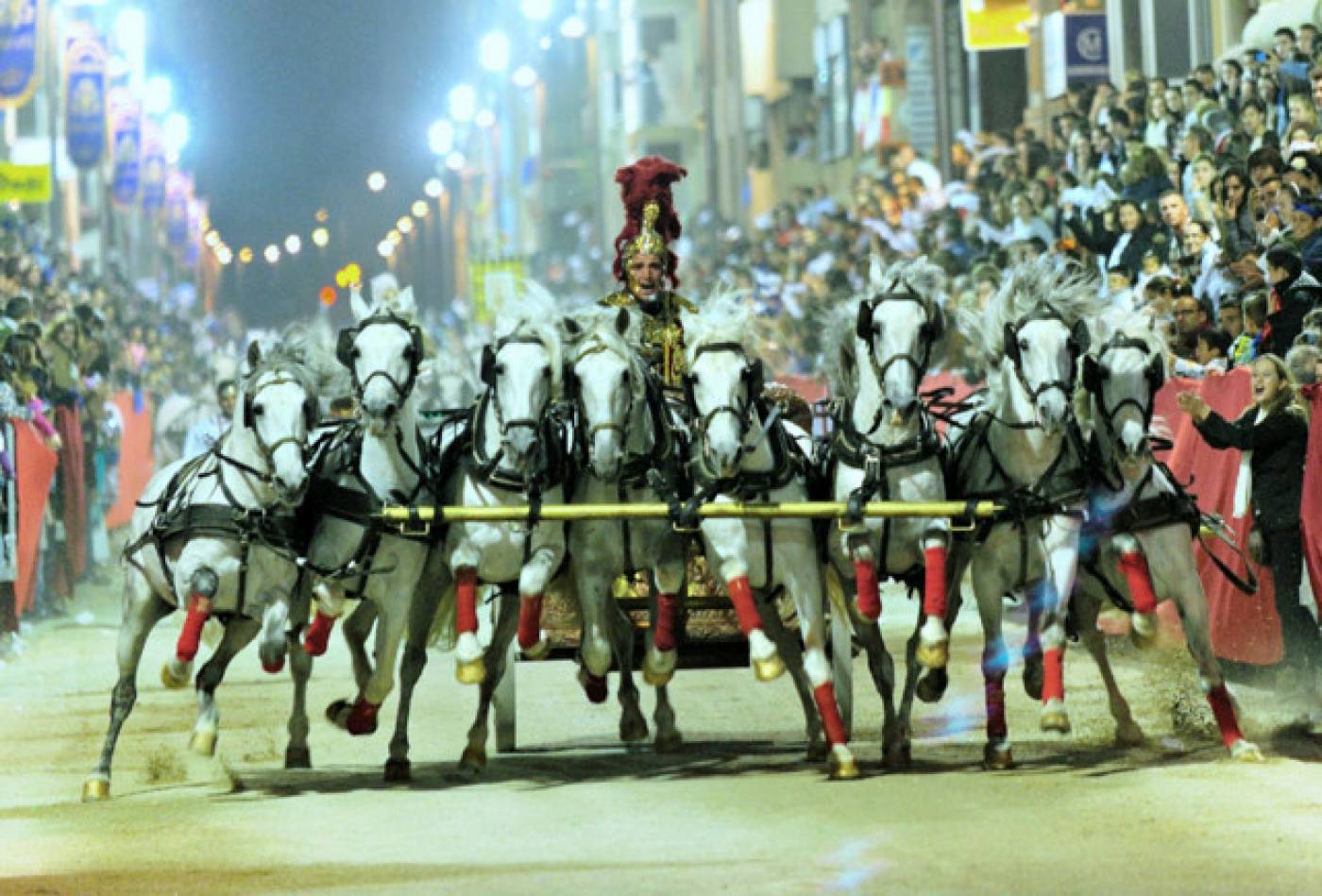 However, in spite of its many attractions, the name of Lorca is synonymous with Easter, (Semana Santa) its biblical parades of International Tourist Interest status and famous throughout Spain. The week includes a series of processions in which the Whites (Paso Blanco) and Blues (Paso Azúl) try to outdo each other with the magnificence of their embroideries and the skill and daring of their horsemen.
Lorca also has a Parador hotel, located within the historic castle.
Opening hours for Lorca tourist office:
Every day of the year apart from 1st and 6th January and 25th December, 10.00 to 14.00 and 16.30 to 18.30 (except Sunday afternoons).
These opening times are often extended and other information points created during the Semana Santa celebrations.
For more local news, events and visiting information go to the home page of Lorca Today