





















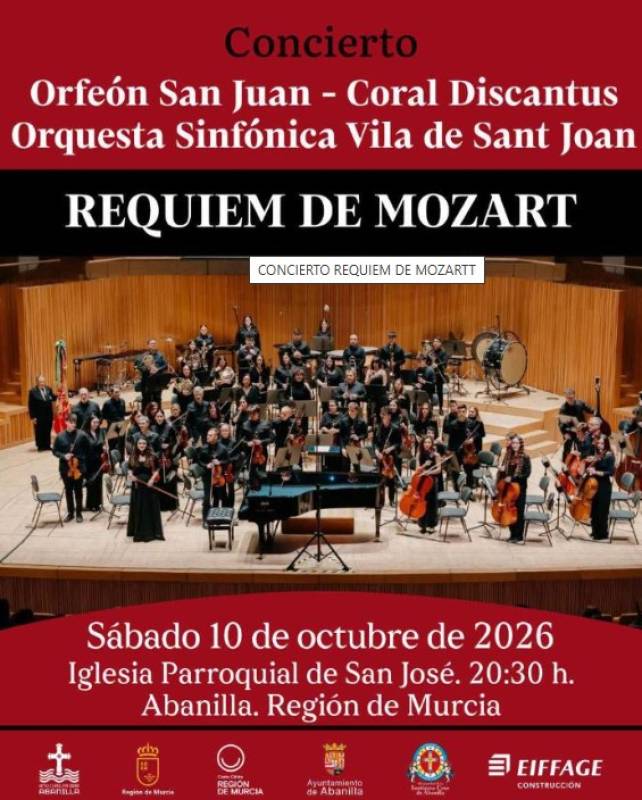
 A special performance of W.A. Mozart’s Requiem is being given at the parish church of San José in Abanilla, in north-eastern Murcia, on Saturday 10th October by the Discantus Choir and the Vila de San Joan Orchestra.
Around 100 people are taking part in the performance of this work, which is acknowledged as one of Mozart’s finest. He composed part of it in late 1791 but it was still not finished when he died in December, and was only definitively attributed to him when it was performed as a benefit concert for his widow Constanze.
As those who have seen the film "Amadeus" will remember, some believe that Mozart was writing for an unknown commissioner, and eventually thought that he was writing it for his own funeral.
The concert in Abanilla begins at 20.30 and admission is free of charge.
For more upcoming events in the Region of Murcia go to the What’s on section of Murcia Today.
Abanilla is a small municipality in the north-east of the region of Murcia, bordering on the province of Alicante. 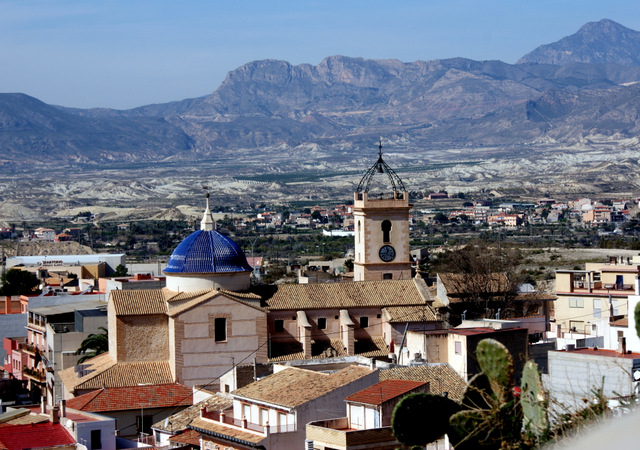 It is currently home to approximately 6,500 inhabitants, a figure which has fallen over the last forty years from almost 9,000 as its neighbour Fortuna has grown correspondingly.
Despite the small population, though, Abanilla occupies 234 square kilometres, and the area is sub-divided into 23 outlying areas, the most heavily populated of which are Barinas, Macisvenda and Mahoya.
Historically, the town is believed to have its origins during the time of the Moorish occupation of southern 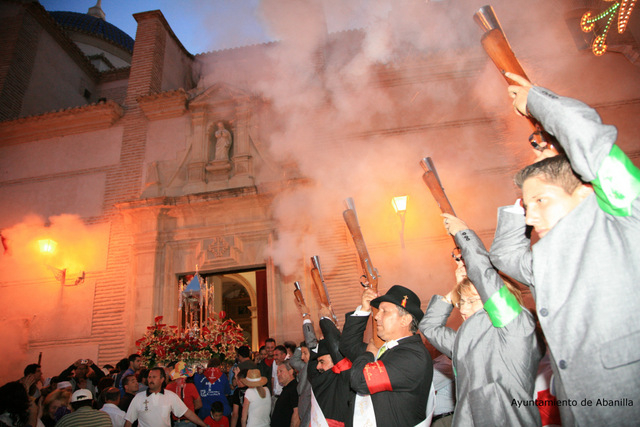 Spain. Indeed the name Abanilla itself is derived from the Arabic “Al Banyala” or “Al-Bayada” (white town), and evidence has been found to show that in the 13th century it was known as Favanella.
Little is left of the settlement in the Middle Ages, although the layout of the town centre recalls the typical narrow, winding streets of that time and there are remnants of the old Arab fortress in El Lugar Alto (the hill above the town on which the statue of Christ now stands). The Town Hall building dates from 1762, and other recommended stops on a tour round the town include the Casa Pintada and the Casa de la Encomienda, where the local governors used to live and collect taxes, the baroque church of San José, which was built by 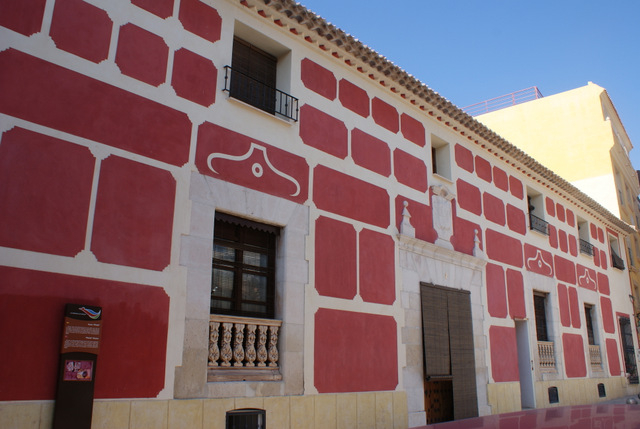 the military and religious order of Calatrava, the fountain in the Calle Mayor and the Casa Cabrera.
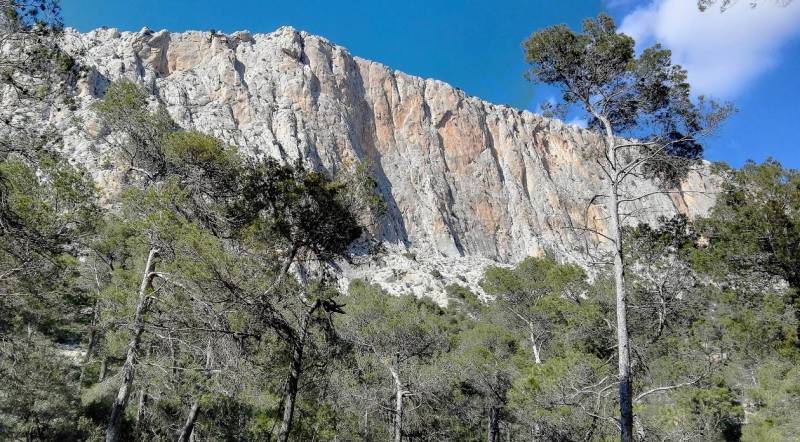
These buildings make a walk around the town centre a pleasant and interesting experience, but no visit to Abanilla is really complete without a trip out into the countryside. The climate here is among the warmest in the south-east of Spain, with an average year-round temperature of 19ºC, and the landscape is among the most spectacular in the Region of Murcia. The Chícamo, for example, is a dry river-bed which now acts as a floodwater run-off channel, starting in the outlying area of Macisvenda, and among the most spectacular parts 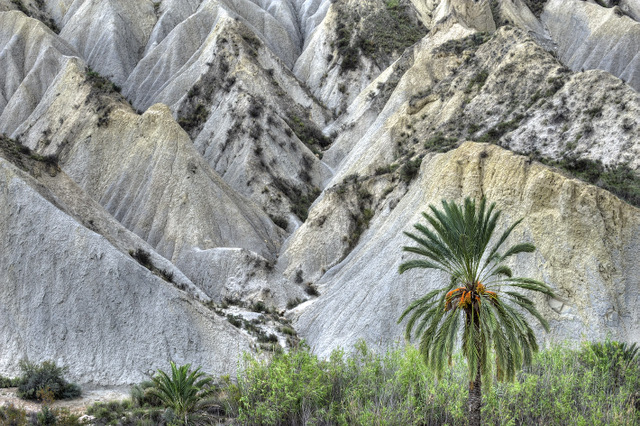 of it is the El Cager canyon. Visitors are strongly advised to take a camera: you won’t be disappointed by this “desert river”!
The same rocks which make the Chícamo such a unique place to visit have traditionally provided the backbone of the local economy, and according to some estimates as much as a third of the Region of Murcia’s building stone is extracted from the numerous quarries in the area. These also supply arids and marble-related limestone.
As is the case elsewhere in the Region of Murcia, among the most important dates in the local calendar are 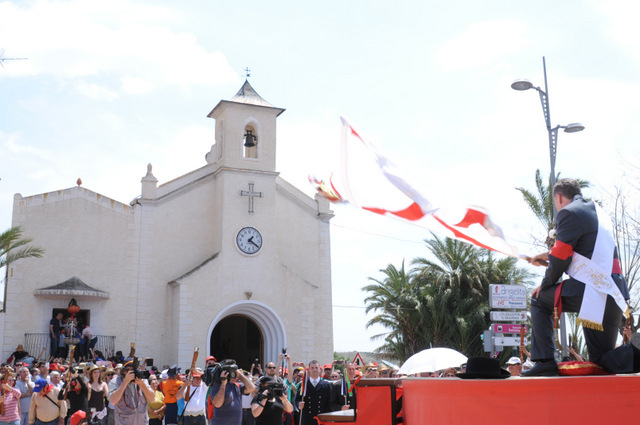 those of the fiestas. In Abanilla these occur mainly in the spring, with the stand-out dates being in late April and early May. On 1st May the “Kábilas Moras y Mesnedas Cristianas” parade is held, and two days later this is followed by a Romería in which the Santísima Cruz (the patron saint of Abanilla) is taken up to the small church in the outlying district of Mahoya.
Even outside fiesta season, though, there are plenty of hostelries to enjoy the local cuisine, which specializes in roast meat, locally-grown beans and artichokes and a variety of desserts and sweets. Wine and olive oil 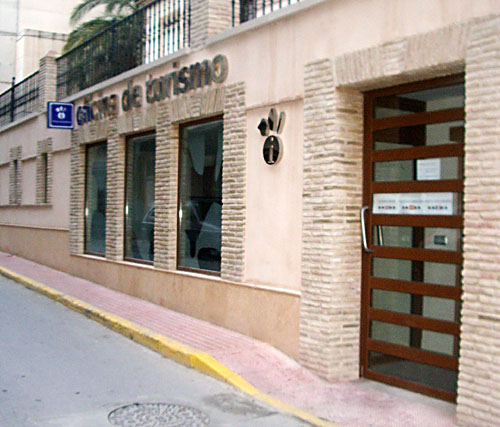 are also produced in Abanilla.
Located just a 25-minute drive from the regional capital and 50 minutes from the beaches of the Mar Menor, Abanilla is within easy reach for those who are interested in seeing the other side of the Region of Murcia.
The tourist office is open in the mornings between Monday and Friday from 8:30am to 14:30pm.
Map
View Abanilla, Murcia in a larger map
Images: Ayto de Abanilla